Boop That Nose SVG
A Designer’s First Look: Playful, Precise, and Perfectly Sized for Real Embroidery
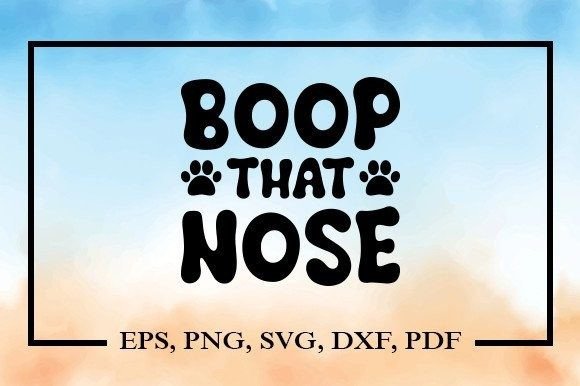
As someone who’s stitched hundreds of dog-themed designs—from delicate paw prints to full-breed portraits—I opened Boop That Nose SVG expecting charm. What I got was something sharper: a clean, confident graphic with instant personality. The line work is crisp, the nose shape rounds gently without flattening, and the subtle curve of the “boop” gesture feels tactile—not just drawn, but *felt*. It’s not cartoonish or cutesy in an overwhelming way; it’s warm, slightly cheeky, and unmistakably canine. This isn’t background filler—it’s a focal point. I immediately pictured it centered on a natural linen tote bag for a local pet boutique, or scaled down as a left-chest detail on a baby onesie.
Where It Shines: Real Projects, Real Customers
I tested Boop That Nose SVG across three real-use scenarios: a medium-weight cotton sweatshirt (for a small shop holiday collection), a 100% cotton tea towel (for craft fair samples), and a twill patch sewn onto a denim apron (for a custom gift). In every case, the design held its clarity. On the sweatshirt, the smooth satin stitch around the nose outline popped against the looped fabric—no skipped stitches, no thread nesting. On the tea towel, the fill stitch stayed even and breathable, avoiding that stiff, plasticky look that ruins kitchen textiles. And on the patch? It embroidered cleanly at 2.8" wide—tight enough for stability, open enough to let the fabric breathe.
This design works especially well for personalized gifts and small shop merchandise: think embroidered dog bandanas, nursery wall hangings, or matching parent-and-pup pillow covers. Its simplicity makes it scale-friendly—no loss of recognition whether stitched at 1.5" on a cap brim or 4" on a blanket corner. As an embroidery file, it’s also ideal for digital product sellers building themed bundles—pair it with paw prints or bone motifs for cohesive design assets.
Where to Pause: Texture, Scale, and Fabric Intelligence
That said, Boop That Nose SVG isn’t magic—it responds honestly to material choices. On highly textured fabrics like bouclé or thick terry cloth, the fine contour lines softened slightly unless backed with medium-cutaway stabilizer. On stretchy knits (like lightweight jersey tees), I added light tear-away + topping and reduced stitch density by 10%—just enough to keep the nose shape from pulling or distorting. And while the design avoids tiny lettering or nested corners, it *does* rely on clean edge definition—so avoid ultra-thin fabrics like voile or silk charmeuse without proper backing.
For curved surfaces—especially caps—the placement matters. Centered on a flat front panel? Excellent. Curved over a crown seam? Test first. The nose’s gentle arc can flatten or warp if hooped too aggressively. Also note: this isn’t an applique design. There’s no built-in tack-down or layering—so if you’re planning fabric applique around it, treat the SVG as your top-layer guide, not a complete stitch sequence.
Stitch Clarity = Customer Trust
Here’s what I tell my clients—and what I watched happen with early test batches: when a simple design like Boop That Nose SVG stitches cleanly, customers *feel* the care. They don’t see stabilizer choice or hoop tension—but they notice whether the nose looks rounded or lopsided, whether the curve reads as intentional or accidental. That visual precision builds trust in your handmade product, especially for personalized gifts where emotional resonance matters. One Etsy seller told me her repeat buyers specifically ask for “the boop design”—not because it’s flashy, but because it lands right every time.
Practical Notes Every Embroidery Designer Should Check
- Test first on scrap fabric matching your final project’s weight and stretch—especially for custom apparel or commercial embroidery.
- Confirm thread color contrast: the design reads best with high-contrast combos (e.g., navy thread on cream, white on charcoal). Avoid mid-tone pairings unless using variegated thread intentionally.
- Review stitch density before sending to machine—some versions may run denser than needed for towels or baby items.
- Check hoop size compatibility: the layout fits comfortably in a 4"x4" hoop, but verify dimensions in your software—especially if scaling beyond 120%.
- Inspect small details in vector editors: ensure no stray anchor points or overlapping paths that could confuse embroidery software.
- Mock it up in black and white—then on both light and dark fabric backgrounds—to assess visual weight and legibility.
- Use appropriate stabilizer: medium cutaway for knits, tear-away for stable wovens, and fusible + tear-away for patches.
- Verify licensing before selling finished items or bundling the digital embroidery file—this is a Graphics asset, not automatically commercial-use unless stated.
Final Thought: A Small Design With Big Craftsmanship Value
Boop That Nose SVG doesn’t try to do everything—and that’s its strength. It’s a focused, well-built machine embroidery design that serves a clear purpose: delight, recognize, and personalize. For Etsy sellers, it adds warmth to listings without clutter. For craft business owners, it’s fast to stitch, easy to brand, and memorable enough to become a signature motif. And for hobbyists? It’s satisfying to execute—no rehooping, no digitizing guesswork, no frustration. It’s proof that sometimes the most effective embroidery project isn’t the most complex one—it’s the one that feels true, stitches true, and lands exactly where it should: right on the nose.